

Assessment 1
Assessment details
|
Unit Code Title |
EDUC2006 Technologies and Design: Secondary Curriculum and Pedagogies |
| Assessment Type | Reflection (written) |
|
Due Date |
Sunday 29th of March by 11.59pm AEST |
| Weight | 40% |
| Length / Duration | 1500 |
| Individual / Group | Individual |
| Unit Learning Outcomes (ULOS) | ULO2 |
Task overview
INTRODUCTION –
For your students, your Technologies classroom could become a place where all students feel safe, equal and valued. This reflection encourages an analysis of differentiation strategies to showcase of how teachers can intentionally utilise strategies for inclusion to encourage positive behaviour, and influence success in the classroom.
Write a reflection that critically discusses strategies for: inclusion, differentiation or classroom routines. Your reflection must reference modalities of adjustments; CONTENT, PROCESS, PRODUCT or LEARNING ENVIRONMENT, linking examples of your own (future/current) teaching to illustrate your approach with further references to support.
Instructions
In this assessment, you will reference two modalities of adjustments (two of: content, process, product or learning environment), and justify how they could be utilised to differentiate teaching outcomes. You will need to justify using research/data to SHOW how adjustments that would suit diverse learners to success in your specific subject.
Suggested structure:
- Introduction: curriculum context and scope, what you teach/subject, and what are the specifics that should be known for this reflection; eg students year
- Differentiation Adjustment 1: quick overview of the modality of adjustment, what you are teaching (exact outcomes), instructional details (how you are teaching it), reflect how this adjustment meets the needs of (diverse) learners, justification of why this strategy best suits the learning for students AND include links to research to enhance your writing.
- Differentiation Adjustment 2: quick overview of the modality of adjustment, what you are teaching (exact outcomes), instructional details (how you are teaching it), reflect how this adjustment meets the needs of (diverse) learners, justification of why this strategy best suits the learning for students AND include links to research to enhance your writing.
- Conclusion: wrap up your reflection by referring back to your chosen strategies and points made (not new ones) and linking to the introduction.
As part of your writing:
- You are writing a reflection (https://www.scu.edu.au/media/scu-dep/current-students/learning-zone/quick-guides/reflective_pdf), therefore you should use first person and write about what you would do in the classroom using future tense
- Use structured paragraphs (https://www.scu.edu.au/media/scu-dep/current-students/learning-zone/quick-guides/writing_pdf) and write a formal conclusion
- Source 4 additional references that support your writing (these can be articles, podcasts, peer reviewed research
- Illustrate what your classroom will be like with specific examples linked to your curriculum (examples)
Include reference to students needs such as (but not limited to): numeracy and literacy supports, identified learning needs (NCCD), cultural and linguistic diversity.
Resources and Checklist
Read the following SCU lib guide to support your reflective writing https://www.scu.edu.au/media/scu-dep/current-students/learning-zone/quick-guides/reflective_writing.pdf
Access: https://education.nsw.gov.au/teaching-and-learning/professional-learning/teacher-quality-and-accreditation/strong-start-great-teachers/refining-practice/differentiating-learning
Watch the following videos:
https://www.youtube.com/watch?v=CyndTjP_Utk&list=PLp5PwTABmlC-CxxPWl6qonRQ SyecZMMn-&index=26
https://youtu.be/ornsytb0NrI (https://youtu.be/ornsytb0NrI)
Draft your work using the suggested structure
Write and refine, checking the rubric and ensuring you are completing required parts of the task.
Resources to help you –
- Writing a proposal (https://www.scu.edu.au/media/scu-dep/current-students/learning-zone/quick-guides/writing_a_pdf)
- Writing paragraphs (https://www.scu.edu.au/media/scu-dep/current-students/learning-zone/quick-guides/writing_pdf)
- Learning Zone (https://www.scu.edu.au/learning-zone/)
- APA 7 Referencing (https://libguides.scu.edu.au/apa)
- Academic Integrity Module (Module for first year students) (https://learn.scu.edu.au/webapps/blackboard/execute/displayLearningUnit?course_id=_141588_1&content_id=_4544290_1)
- Academic Integrity (https://www.scu.edu.au/about/academic-portfolio-office-apo/academic-integrity -framework/)
Deliverables & submissions
Submission of your document is to be via TURNITIN. The submission link can be found in the Assessment Tasks and Submission Tab in BlackBoard.
It is YOUR responsibility to ensure that you have submitted the correct file and the FINAL version of your assessment for marking BEFORE the due date/time.
After you have followed the TurnItin submission process you will receive an email. CHECK YOUR STUDENT EMAIL AND KEEP A COPY OF THIS. If you do not receive this email, this
means that your assessment has not been properly submitted.
If you have any difficulty submitting your assignment, please contact Technology Services (https://www.scu.edu.au/technology-services/) and make sure that you log a job with them so you have evidence of your attempted submission. To avoid any last-minute problems, make sure you submit well before 11.59pm on the required date of submission.
Referencing
You are to use the APA7 style for citations and referencing
For any written work where you use or refer to a source of information or image that is not your own, APA 7th referencing protocols must be used. Refer to the following source if you are unsure as to what is required: https://libguides.scu.edu.au/apa/about-apa (https://libguides.scu.edu.au/apa/about-apa)
GenAI use
This assessment is classified as:
- Level 3: AI use not You must not use AI for any part of the assessment.
GenAI may not be used for this assessment.
Generative Artificial Intelligence (GenAI) tools, such as ChatGPT, may not be used for this Assessment Task. You are required to demonstrate if you have met the units skills and knowledge without the support of GenAI. If you use GenAI tools in your assessment task, it may result in an academic integrity breach against you as described in the Student Academic and Non-Academic Misconduct Rules, Section 3 (https://policies.scu.edu.au/document/view-current.php?id=141#section3).
Assessment document and rubric
This rubric outlines the grading criteria your submission will be assessed against, along with the standards expected for each grade level. For further information, refer to Final Grades (https://www.scu.edu.au/current-students/student-administration/final-grades/).
| What knowledge and skills do I need to demonstrate in this task? |
| Critically discuss pedagogical approaches to teaching 7-10 Technologies subjects including the management of appropriate resources and WH&S relevant to Technologies (including those that support literacy and numeracy) and the integration of ICT |
| SUBMISSION INSTRUCTIONS – How do I submit this task? |
| Submission of your document is to be via TURNITIN. The submission link can be found in the Assessment Tasks and Submission
Tab in BlackBoard. It is YOUR responsibility to ensure that you have submitted the correct file and the FINAL version of your assessment for marking BEFORE the due date/time.
After you have followed the TurnItin submission process you will receive an email. CHECK YOUR STUDENT EMAIL AND KEEP A COPY OF THIS. If you do not receive this email, this means that your assessment has not been properly submitted.
If you have any difficulty submitting your assignment, please contact Technology Services and make sure that you log a job with them so you have evidence of your attempted submission. To avoid any last-minute problems, make sure you submit well before 11.59pm on the required date of submission. |
| ACADEMIC INTEGRITY – How do I ensure my work has academic integrity? |
| GenAI may not be used for this assessment.
Generative Artificial Intelligence (GenAI) tools, such as ChatGPT, may not be used for this Assessment Task. You are required to demonstrate if you have met the units skills and knowledge without the support of GenAI. If you use GenAI tools in your assessment task, it may result in an academic integrity breach against you as described in the Student Academic and Non-Academic Misconduct Rules, Section 3.
For any written work where you use or refer to a source of information or image that is not your own, APA 7th referencing protocols must be used. Refer to the following source if you are unsure as to what is required: |
| https://libguides.scu.edu.au/apa/about-apa
Your written document should be cheked through TURNITIN before submission to check for Academic Integrity. The link for Turnitin can be found in the Assessment Tasks and Submission area on BlackBoard. You will receive a similarity report which checks that you have referenced your work correctly. The % of similarity should ideally be below 10%, but must be less than 15%. Once you have checked the report, make any referencing adjustments required to bring the similarity below 10% before the submission date. |
| LATE SUBMISSION/EXTENSION – What do I need to know/do? |
| If you need to apply for special consideration you may do so using the following link: https://www.scu.edu.au/current-students/student-administration/special-consideration/
According to SCU Policy, penalties apply for late submissions. For more information use the link below: (https://policies.scu.edu.au/view.current.php?id=00255 |
| RESOURCES – What resources will I need to complete this task? |
| Resources to help you –
• Academic Integrity Module (Module for first year students) |
EDUC2006 Marking rubric
| Criteria | HD+ | HD | D | C | P | MF | F | N/A |
| 1.
Understandin g & Justification of Strategies 40% |
Excellent explanation of highy appropriate adjustments that are linked to specific syllabus outcomes. A very strong justification supported by 4+ credible references integrated into writing. | Comprehensive explanation of both adjustments, explicitly linked to syllabus outcomes. Strong justification supported by 4+ credible references integrated into writing. | Clear explanation of both adjustments with syllabus links.
Justification supported by 3–4 references. |
Adequate explanation with some syllabus links. Justification supported by 2–3 references. | Basic explanation; minimal syllabus links. Justification supported by 1–2 references. | Basic explanation; minimal syllabus links. Justification is inadequate or too week even though supported by 1–2 references. | Adjustments unclear or unrelated to syllabus. No justification or references. | No Attempt/ unauthorised use of AI |
| 2.
Instructional Examples & Classroom Illustration 40% |
Provides 2+ highly detailed instructional examples per appropriate adjustments, very clearly showing classroom implementation and relevance for diverse learners (e.g., numeracy and literacy supports, NCCD, cultural diversity) in a junior class context. | Provides 2+ detailed instructional examples per strategy, clearly showing classroom implementation and adjustments for diverse learners (e.g., numeracy and literacy supports, NCCD, cultural diversity) | Provides at least 1 detailed example per strategy, showing classroom implementation and some adjustments for diverse learners. | Provides general examples with adequate detail; mention of adjustments could be more clearer to illustrate implementation for diverse learners. | Provides general examples with basic details; minimal mention of adjustments for diverse learners. | Provides general examples with limited details; inadequate mention of adjustments for diverse learners. | Provides vague or incomplete examples; no clear adjustments.No examples provided. | No Attempt/ unauthorised use of AI/ or the work of others |
| 3. Structure & Proposal Format 10% | Exact structure (intro, two adjustments, conclusion). Writing is very concise, logical, clear and very close to word limit. | Follows proposal structure (intro, two adjustments, conclusion). Writing is concise, logical, clear and close to word limit. | Follows proposal structure (intro, two adjustments, conclusion). Writing is logical, and within word limits +/- 5%. | Mostly follows structure; minor lapses in flow or clarity. 10%
+/- word limit. |
Structure evident but inconsistent; exceeds/under word limit by 20%. | Limited structure; exceeds/under word limit by 30%. | No clear structure; significantly outside word limit. | No Attempt/ unauthorised use of AI/ or the work of others |
| 4. Academic Writing & Referencing 10% | APA 7th referencing accurate throughout; all sources cited correctly in-text and reference list. | APA 7th referencing accurate throughout; all sources cited correctly in-text and most of the reference list. | APA 7th referencing mostly accurate throughout; most sources cited correctly in-text and most of the reference list. | A few minor errors in APA referencing; sources mostly cited correctly | A number of minor errors/ or a major error in APA referencing; sources mostly cited correctly | Several APA errors; incomplete citations. | Attempted APA referencing but inaccurate or incomplete | No referencing provided |
EDUC2006 Sample A1
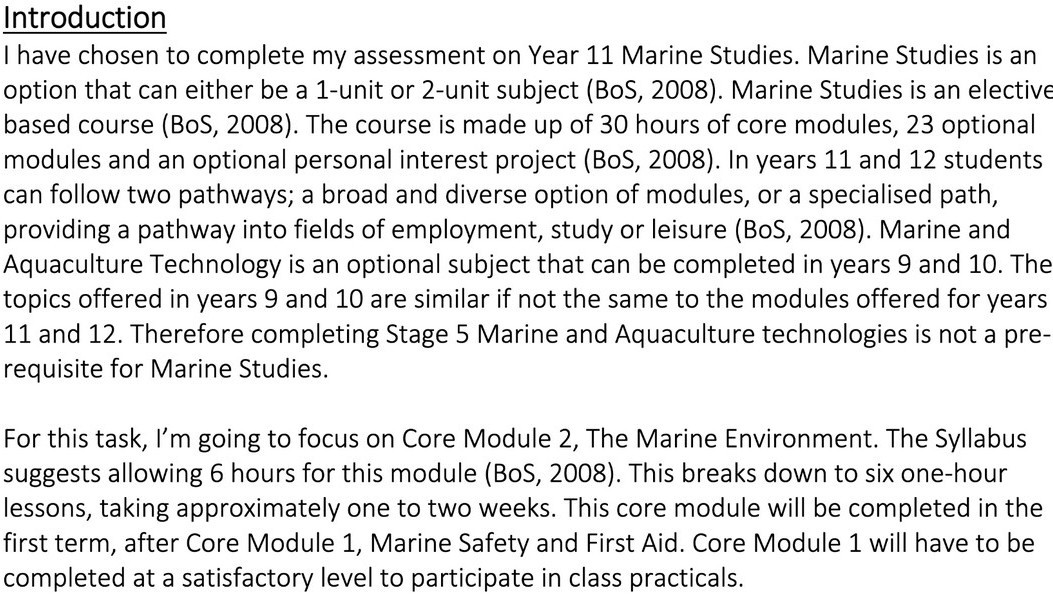 |
This sample introduction provides a contextual background that describes the subject that will be referenced in this reflection.
Could be improved by: – Too many specifics are included that are not related to the task, hours, pathways, module details – these are not required. – Using formal language “I am” in replace of I’m and, deleting first line (not required and starts as passive voice). – Citations not correct (Board of Studies, 2008) – Always capitalising where appropriate – eg: Year 9 and Technologies |
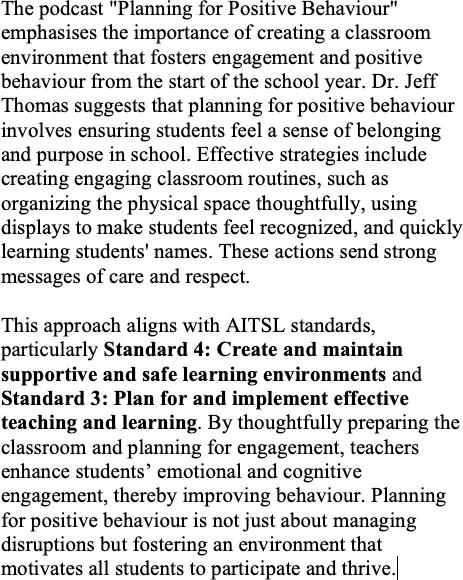 |
Read the first paragraph aloud, there is a good understanding of the synopsis of the podcast, as only one media is referenced, it is presented as a description of the podcast, not a critical discussion.
Could be improved by: – Quotation marks “Podcast name” not required. – No citations for references – Descriptions that are not linked with a curriculum/subject examples, strategies are generally described. |
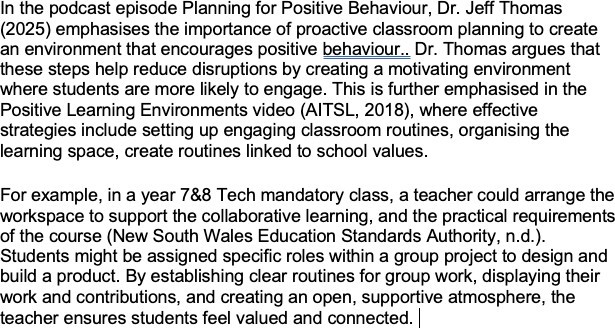 |
Clear understanding of two resources (video and podcast), connections of SIMILARITIES are made between them in a critical discussion.
Great examples of what they would do in classroom – specific and easy to follow “for example. . .”
Could be improved by: – Capitalisation required for course and full name should be used – Examples could be taken FURTHER and extended with additional research/citations, only the suggested resources are used. |