
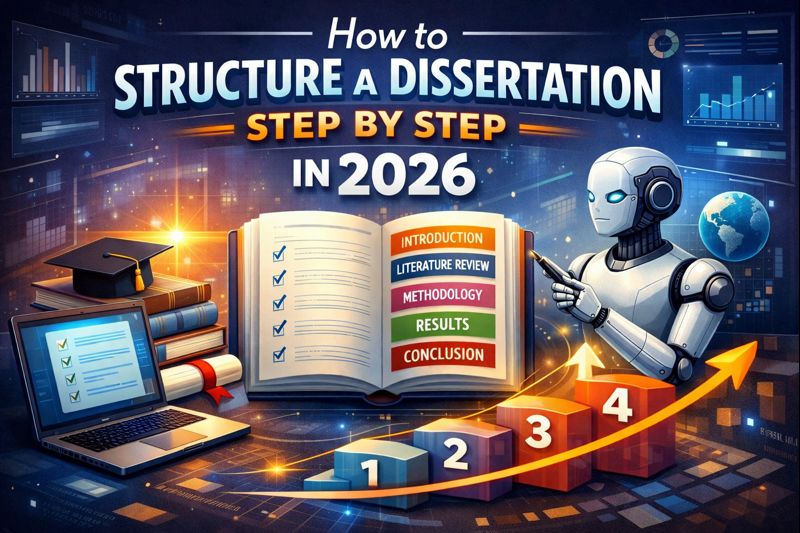
Writing a dissertation is one of the most important academic milestones in undergraduate, master’s, and doctoral programs. It demonstrates your ability to conduct independent research, apply theoretical knowledge, analyze data critically, and contribute meaningfully to your field of study. However, many students struggle not because of the research itself, but because they are unsure how to structure a dissertation correctly.
This comprehensive guide explains how to structure a dissertation step by step, breaking down each chapter, its purpose, and what to include. Whether you are in nursing, business, social sciences, or STEM fields, this guide will help you create a clear, logical, and academically sound dissertation structure.
What Is a Dissertation?
A dissertation is a formal, extended academic document that presents original research conducted by a student as part of a degree requirement. It is usually required at the undergraduate (final year project), master’s, and doctoral (PhD) levels.
Unlike essays or term papers, a dissertation:
- Focuses on an original research question
- Uses systematic research methods
- Includes extensive literature review and analysis
- Follows a strict academic structure
Understanding the standard dissertation structure is essential before you begin writing.
Overview of the Standard Dissertation Structure
Although requirements vary slightly by institution and discipline, most dissertations follow this general structure:
- Title Page
- Abstract
- Acknowledgements (optional)
- Table of Contents
- List of Figures and Tables
- Chapter 1: Introduction
- Chapter 2: Literature Review
- Chapter 3: Methodology
- Chapter 4: Results / Findings
- Chapter 5: Discussion
- Chapter 6: Conclusion and Recommendations
- References
- Appendices
The following sections explain each part step by step in detail.
Step 1: Title Page
The title page is the first impression of your dissertation and must follow your institution’s formatting guidelines precisely.
What to Include on the Title Page
- Dissertation title (clear, concise, and specific)
- Your full name
- Degree program and department
- University name
- Submission date
- Supervisor’s name (if required)
Tips for Writing a Strong Dissertation Title
- Avoid vague or overly broad titles
- Include key variables or concepts
- Reflect the scope and focus of your research
Example:
The Impact of Artificial Intelligence on Clinical Decision-Making in Emergency Nursing Practice
Step 2: Abstract
The abstract is a brief summary of the entire dissertation, usually between 150–300 words, depending on institutional guidelines.
What to Include in the Abstract
- Research problem or aim
- Research methods used
- Key findings
- Main conclusions or implications
Important Abstract Writing Tips
- Write the abstract last, even though it appears at the beginning
- Use past tense
- Do not include citations
- Be concise but informative
The abstract should allow readers to quickly understand what your research is about and why it matters.
Step 3: Acknowledgements (Optional)
The acknowledgements section allows you to express gratitude to individuals who supported your academic journey.
Commonly Acknowledged Individuals
- Dissertation supervisor or advisor
- Lecturers or committee members
- Family and friends
- Funding bodies or institutions
This section is written in a personal but professional tone and is usually brief (one page or less).
Step 4: Table of Contents
The table of contents provides a roadmap of your dissertation and helps readers navigate the document easily.
What the Table of Contents Includes
- Chapter titles and subheadings
- Page numbers
- Lists of figures and tables (sometimes separate)
Ensure that all headings and page numbers match exactly with the text.
Step 5: List of Figures and Tables (If Applicable)
If your dissertation includes graphs, charts, images, or tables, you must list them separately.
Why This Section Is Important
- Improves readability
- Helps examiners locate visual data quickly
- Demonstrates academic organization
Each figure or table should be clearly labeled and numbered consistently throughout the dissertation.
Step 6: Chapter 1 – Introduction
The introduction sets the foundation for your entire dissertation. It explains what you are researching and why.
Key Elements of the Introduction Chapter
- Background of the study
- Statement of the research problem
- Research aims and objectives
- Research questions or hypotheses
- Significance of the study
- Scope and limitations
- Structure of the dissertation
Writing Tips for Chapter 1
- Move from general context to specific problem
- Clearly justify the need for your research
- Avoid presenting results or conclusions
A strong introduction convinces the reader that your research is relevant and worthwhile.
Step 7: Chapter 2 – Literature Review
The literature review critically examines existing research related to your topic.
Purpose of the Literature Review
- Demonstrates knowledge of your field
- Identifies research gaps
- Theoretically grounds your study
- Justifies your research questions
What to Include in a Literature Review
- Key theories and models
- Empirical studies relevant to your topic
- Methodological approaches used by other researchers
- Strengths and weaknesses of previous studies
Best Practices
- Organize by themes, not by authors
- Use recent, peer-reviewed sources
- Critically analyze rather than summarize
This chapter shows that your research is built on a solid academic foundation.
Step 8: Chapter 3 – Methodology
The methodology chapter explains how your research was conducted.
Key Components of the Methodology Chapter
- Research design (qualitative, quantitative, or mixed methods)
- Research approach (descriptive, experimental, exploratory, etc.)
- Population and sample
- Sampling techniques
- Data collection methods
- Data analysis procedures
- Ethical considerations
- Limitations of the methodology
Writing Tips
- Be precise and detailed
- Justify your methodological choices
- Write in past tense
This chapter allows other researchers to replicate or evaluate your study’s credibility.
Step 9: Chapter 4 – Results / Findings
The results chapter presents the data collected during the study without interpretation.
What to Include in the Results Chapter
- Descriptive statistics or themes
- Tables, charts, and graphs
- Key findings aligned with research questions
Important Guidelines
- Do not interpret results here
- Present findings logically and clearly
- Refer to tables and figures in the text
For qualitative studies, this chapter may present themes supported by participant quotations.
Step 10: Chapter 5 – Discussion
The discussion chapter interprets the results and explains their significance.
Key Elements of the Discussion Chapter
- Interpretation of key findings
- Comparison with existing literature
- Explanation of unexpected results
- Theoretical and practical implications
Writing Tips
- Link findings back to research questions
- Use literature to support interpretations
- Maintain a critical and analytical tone
This chapter demonstrates your ability to think critically and synthesize information.
Step 11: Chapter 6 – Conclusion and Recommendations
The conclusion summarizes the entire study and highlights its contributions.
What to Include in the Conclusion
- Summary of key findings
- Overall conclusions
- Contribution to knowledge
- Practical or policy recommendations
- Suggestions for future research
Common Mistakes to Avoid
- Introducing new data
- Repeating the discussion word-for-word
- Making unsupported claims
A strong conclusion leaves a lasting impression on examiners.
Step 12: References
The references section lists all sources cited in your dissertation.
Key Referencing Tips
- Follow the required citation style (APA, MLA, Harvard, Chicago)
- Ensure all in-text citations appear in the reference list
- Maintain consistent formatting
Accurate referencing demonstrates academic integrity and professionalism.
Step 13: Appendices
Appendices include supplementary materials that support your research but are too detailed for the main text.
Common Appendix Materials
- Questionnaires
- Interview guides
- Consent forms
- Extended data tables
- Ethical approval letters
Each appendix should be clearly labeled and referenced in the main text.
Final Tips for Structuring a Dissertation Successfully
- Always follow your university’s dissertation guidelines
- Start with a clear outline before writing
- Maintain consistency in formatting and headings
- Allow time for editing and proofreading
- Seek feedback from your supervisor regularly
Conclusion
Understanding how to structure a dissertation step by step is crucial for academic success. A well-organized dissertation not only improves clarity and coherence but also enhances the credibility of your research. By following the structure outlined in this guide, you can confidently approach each chapter and produce a dissertation that meets academic standards and impresses examiners.
If you need professional support with dissertation writing, editing, or formatting, working with our experienced academic writers can save time and reduce stress—allowing you to focus on achieving top grades.