
|
EDUC2006 Technologies and Design: Secondary Curriculum and Pedagogies |
Assessment Task 2 |
Submission date Week 6 ,Monday, 20/04/26, 11:59 pm AEST |
Task Weighting 60% |
Approx. 2000 words (copied curriculum content excluded from word count) |
| THE TASK – What do I need to do? | ||||
|
Create a unit of work and lesson materials suitable for Years 7-10 curriculum/syllabus/outcomes from the State in which you intend to teach in, and the context area/subject is your choice. Before you start let your tutor know which state and subject you will be writing for and check the curriculum documentation you are referencing is correct.
By creating a unit of work you are practicing formulating sequences of strategies and learning activities that are aligned to curriculum. This will also provide you with a unit of work you can use when you start teaching.
Part 1: Unit of work: First four weeks of a termly plan • Use the template provided include: unit title, outcomes, context/specialisation, general capabilities and cross- curriculum priorities • Each of the weekly sections in the unit of work should include lesson activities and links to resources (only one resource required for submission)
Assessment outcomes
• Your unit of work and lesson materials must demonstrate clear alignment between curriculum outcomes, learning activities, teaching strategies and assessment approaches so that learning progresses logically across the sequence of lessons and supports cumulative knowledge development over time. [CC 2.1.1 (A)] [CC 2.1.2 (A)] [CC 2.1.3 (A)] • Your planning should demonstrate the use of evidence-informed teaching practices, including explicit instruction, clear sequencing of content, modelling of new knowledge or skills, opportunities for retrieval and review of prior learning, and scaffolding that supports students to move from guided practice toward independent application. [CC 2.2.1 (A)] [CC 2.2.2 (A)] [CC 2.2.3 (A)] [CC 2.2.4 (A)] [CC 2.2.5 (A)] [CC 2.2.6 (A)] • Your unit should also demonstrate how literacy and numeracy are intentionally incorporated within Technologies learning activities so that students develop discipline-specific reading, writing, interpretation and quantitative reasoning skills. [CC 2.4.1 (A)] [CC 2.4.2 (A)] [CC 2.4.3 (A)] [CC 2.5.1 (A)] [CC 2.5.2 (A)] [CC 2.5.3 (A)] [CC 2.5.4 (A)] • Your unit plan should clearly demonstrate how learning outcomes, lesson activities and assessment opportunities are aligned with curriculum expectations and designed to support progressive development of knowledge and skills. [CC 2.1.1 (A)] • The weekly learning sequence should demonstrate how new knowledge is introduced, revisited and strengthened through opportunities for practice and consolidation across the four weeks of learning. [CC 2.1.2 (A)] • The structure of the learning sequence should show logical sequencing of tasks and increasing complexity so that students build understanding progressively toward mastery. [CC 2.1.3 (A)] • The unit plan should also show where literacy practices such as reading technical information, interpreting diagrams or communicating design ideas are integrated within the Technologies learning context. [CC 2.4.1 (A)] [CC 2.4.2 (A)] [CC 2.4.3 (A)] |
||||
| • Where relevant, the unit should also include opportunities for students to engage with numeracy concepts such as measurement, estimation, calculation, data interpretation or quantitative reasoning relevant to Technologies contexts. [CC 2.5.1 (A)] [CC 2.5.2 (A)]
Part 2: Lesson Materials • One (55min) lesson plan using template provided • One teaching resource should be created, eg: Doc, Canva, PPT • These two items MUST be linked, and can be from any part of the unit
Assessment outcomes • The lesson plan must demonstrate explicit teaching strategies including clear explanation of concepts, structured sequencing of learning activities, and careful presentation of information to support student understanding. [CC 2.2.1 (A)] [CC 2.2.2 (A)] [CC 2.2.3 (A)] • The lesson materials should include modelling or demonstration of key knowledge, processes or skills so that students can observe expert thinking or practice before attempting the task themselves. [CC 2.2.4 (A)] • The lesson materials should include opportunities for students to recall, practise or apply previously learned knowledge as part of the learning process. [CC 2.2.5 (A)] • The lesson materials should demonstrate how teaching and scaffolding support students to gradually move toward independent completion of learning tasks. [CC 2.2.6 (A) • Your lesson materials should also demonstrate how literacy and numeracy learning opportunities are embedded within Technologies learning tasks. [CC 2.4.1 (A)] [CC 2.4.2 (A)] [CC 2.4.3 (A)] [CC 2.5.3 (A)] [CC 2.5.4 (A)] |
| PREPARATION – Checklist on how to approach this task |
| a Choose your curriculum (State, subject, year level – tell your Tutor)
a Check the curriculum outcomes you will be teaching a Fill in Unit Overview a Plan the 4 Weeks of teaching, each week should include: Lesson activities and Teaching strategies and resource link a Ensure you have included Literacy & Numeracy and oportuntiies for differentiation and adjustment a Create One Lesson Plan (55 min) a Create One Teaching Resource a Link the Lesson & Resource (show clearly where it is used) a Links, resources and references to be hyperlinked and embedded in both the unit plan and lesson plans a APA referencing to be used when and if required (eg for a textbook) a Final Check |
| What knowledge and skills do I need to demonstrate in this task? |
| 1. demonstrate a sound understanding of the role, rationale and content of the Technologies curriculum including opportunities to support literacy and numeracy
2. critically discuss pedagogical approaches to teaching 7-10 Technologies subjects including the management and use of appropriate resources and WH&S relevant to Technologies (including those to support literacy and numeracy) and the integration of ICT
3. develop teaching strategies for access and inclusivity in the classroom including those required to meet the needs of Aboriginal and Torres Strait Islander students, NESB students, students with special needs and the literacy and numeracy needs of students |
| 4. develop project-based programs, units of work and lesson plans for sequential learning that encourage creativity and innovation and include literacy and numeracy learning combined with design fair, reliable and valid assessment tasks both for learning and of learning. |
| SUBMISSION INSTRUCTIONS – How do I submit this task? |
| Submission of ONE document (word not PDF) is to be done via TURNITIN. The submission link can be found in the Assessment Tasks and Submission Tab on BlackBoard.
Make a page break between your three sections – submit ONE FILE only Submission of your document is to be via TURNITIN.
The submission link can be found in the Assessment Tasks and Submission Tab in BlackBoard. It is YOUR responsibility to ensure that you have submitted the correct file and the FINAL version of your assessment for marking BEFORE the due date/time.
After you have followed the TurnItin submission process you will receive an email. CHECK YOUR STUDENT EMAIL AND KEEP A COPY OF THIS. If you do not receive this email, this means that your assessment has not been properly submitted.
If you have any difficulty submitting your assignment, please contact Technology Services and make sure that you log a job with them so you have evidence of your attempted submission. To avoid any last-minute problems, make sure you submit well before 11.59pm on the required date of submission. |
| ACADEMIC INTEGRITY – How do I ensure my work has academic integrity? |
| GenAI may be used for this assessment.
Generative Artificial Intelligence (GenAI) tools, such as ChatGPT, may be used for this Assessment Task. If you use GenAI tools, you must use these ethically and acknowledge their use. To find out how to reference GenAI in your work consult the referencing style for your unit via Learning Zone. If you are not sure how to, or how much you can use GenAI tools in your studies, contact me as your Unit Assessor. If you use GenAI tools without acknowledgment it may result in an academic integrity breach against you as described in the Student Academic and Non-Academic Misconduct Rules, Section 3.
Acceptable limits: Based on the Academic Quality, Standards and Integrity Policy, Principle 7 (clause 44c), the acceptable limit for the use of GenAI for this assessment task is defined as: • The use of ANY tools that fall into the following categories: text content creation, language translation, image creation MAY be used • NO tools from the following categories: sound content creation, coding creation, video creation. ALL GenAI generated content in this assessment must be acknowledged using the relevant referencing style for your unit – see the Learning Zone The proportion of GenAI content should not exceed 20% – all AI generated content should be visible, highlighted through acknowledgement and clearly identified through referencing. |

| For any written work where you use or refer to a source of information or image that is not your own, APA 7th referencing protocols must be used. Refer to the following source if you are unsure as to what is required: https://libguides.scu.edu.au/apa/about-apa
Your written document should be checked through TURNITIN before submission to check for Academic Integrity. The link for Turnitin can be found in the Assessment Tasks and Submission area on BlackBoard. You will receive a similarity report which checks that you have referenced your work correctly. You are expected to copy and paste outcomes and content from your state’s syllabus/curriculum documents. Similarity checker should demonstrate the areas of copying and pasting from the syllabus/curriculum documents. The similarity could be anywhere from 15%-20%. |
| LATE SUBMISSION/EXTENSION – What do I need to know/do? |
| If you need to apply for special consideration you may do so using the following link: https://www.scu.edu.au/current-students/student-administration/special-consideration/
According to SCU Policy, penalties apply for late submissions. For more information use the link below: (https://policies.scu.edu.au/view.current.php?id=00255 |
| RESOURCES – What resources will I need to complete this task? |
| Resources to help you –
• Academic Integrity Module (Module for first year students) |
Task 1 Marking rubric
| Criteria | HD+ | HD | D | C | P | MF | F | N/A |
| Designs learning experiences that engages students and encourages creativity and innovation (25%) | The design of the learning experiences in the unit/lesson plan is comprehensive. They are extremely engaging and encourage high levels of participation and active engagement. Sequencing of activities is exceptionally well considered and clearly demonstrates explicit teaching practices including modelling, retrieval, scaffolding and guided-to- independent learning with strong logical progression across the learning sequence. | The design of the learning experiences in the unit/lesson plan is detailed. They are very engaging and encourage high levels of participation and active engagement.
Sequencing of activities is very well considered with clear evidence of explicit instruction, modelling and logical instructional steps that support student understanding and progression of learning. |
The design of the learning experiences in the unit/lesson plan is good – routines for learning may/not be present. They are at times engaging.
Activities are mostly sequenced well with evidence of explicit teaching strategies and structured learning progression. |
Designed learning experiences. They are at times engaging/mostly teacher centric.
Routines for learning may/not be present and evidence of explicit teaching practices such as explanation, modelling, guided practice or scaffolding is limited or inconsistent. Learning activities demonstrate some sequencing of learning and progression of understanding. |
Did not design any learning experiences and/or none were engaging. Routines for learning not be present and no evidence of explicit teaching strategies or sequencing of learning. | No evidence provided/ or no attempt. | Incomplete unit plan. | No Attempt/ unauthorised use of AI |
| Demonstrates an understanding of curriculum and syllabus documents (10%) | Outstanding understanding of curriculum and syllabus requirements is evident in both the unit of work and the lesson plans with clear alignment between outcomes, lesson activities, and the assessment task across the learning sequence. | Thorough understanding of curriculum and syllabus requirements is evident in both the unit of work and the lesson plans with clear links between outcomes and planned learning experiences across the sequence of lessons. | Good understanding of curriculum and syllabus requirements is evident in both the unit of work and the lesson plans with most activities aligned to the intended learning outcomes. | An understanding of curriculum and syllabus requirements is evident. Some errors in presentation of information or inclusion of incorrect information or limited alignment between outcomes and lesson activities.
Learning activities show basic alignment between curriculum outcomes and planned learning experiences. |
Little or no understanding of curriculum and syllabus requirements is evident. | No evidence provided/ or no attempt. | Incomplete sections and/ior incorrect references to curriculum. | No Attempt/ unauthorised use of AI/ or the work of others |
| Caters for learner | Diversity of learners is included to an | Diversity of learners is included to a very high | Diversity of learners is included. This is evident | Diversity of learners is included. This is evident | Strategies to support student diversity are | No evidence provided/ or no | No clear structure; | No Attempt/ unauthorised |
| diversity (5%) | exemplary standard. This is evident in your inclusion of one or more the following: Aboriginal and Torres Strait Islander students, NESB students, students with special needs with explicit differentiation strategies embedded within lesson activities and clear scaffolding supporting progression toward independent learning. | standard. This is evident in your inclusion of one or more the following: Aboriginal and Torres Strait Islander students, NESB students, students with special needs with clear strategies supporting participation and learning. | in your inclusion of one or more the following: Aboriginal and Torres Strait Islander students, NESB students, students with special needs with some strategies supporting learning needs. | in your inclusion of one or more the following: Aboriginal and Torres Strait Islander students, NESB students, students with special needs but strategies are limited or not clearly embedded in learning activities. Some evidence of scaffolding or adjustment to support different learners may be present. | not included. | attempt. | significantly outside word limit. | use of AI/ or the work of others |
| Quality of resourcing (10%) | Lesson plan and resource demonstrate an exemplary standard of organisation, teaching resources and consideration of practical implications (such as WHS) with materials that strongly support modelling, explanation, guided practice and independent student application. | Plans demonstrate a very high standard of organisation, teaching resources and consideration of practical implications (such as WHS) with resources that support clear teaching and learning. | Plan/resource demonstrates a high standard of organisation, teaching resources and consideration of practical implications (such as WHS) with appropriate learning materials that support teaching and learning activities. | Plan/resource demonstrates organisation, teaching resources and consideration of practical implications (such as WHS) but resources may be limited in supporting explicit teaching or student practice. | Plan/resource does not demonstrate organisation, teaching resources or consideration of practical implications (such as WHS). | Limited attempt with teaching resource and/or plans | Incomplete section, provides minimal or no evidence of differentiation. | |
| Numeracy and Literacy (5%) | Strategies to support numeracy and literacy learning are outstanding and are provided through a variety of activities that are explicitly taught, modelled and applied within the Technologies learning context and clearly support student understanding and application. | Strategies to support numeracy and literacy learning are contextual and relevant and are provided through a variety of activities that support student understanding and application. | Strategies to support numeracy and literacy learning are very good and are provided through one or more activities that link to the learning focus and support student understanding. | Strategies to support numeracy or literacy learning are evident and/or limited to only one activity. Literacy or numeracy learning opportunities are included within the learning activities. | Strategies to support numeracy and/or literacy learning are not included. | No evidence provided/ or no attempt. | Submitted presentation does not meet academic standards.
Attempted APA referencing but inaccurate or incomplete |
No referencing provided |
| Quality of writing and referencing (5%) | Outstanding presentation and professional use of templates. Consistently correct spelling and grammar. Referencing is accurate and consistent. | Polished presentation and professional use of templates. Consistently correct spelling and grammar. Referencing is mostly accurate and consistent. | Presentation and professional use of templates mostly consistent. Some spelling and grammar errors. Referencing generally appropriate. | Presentation and use of templates inconsistent. Frequent spelling and grammar errors.
Referencing may be incomplete or inconsistent. |
Poor presentation, referencing, grammar and spelling. | No evidence provided/ or no attempt. |
2026 EDUC2006 UNIT PLAN SAMPLES
| EXAMPLE OF GREAT LAYOUT AND FORMATTING |
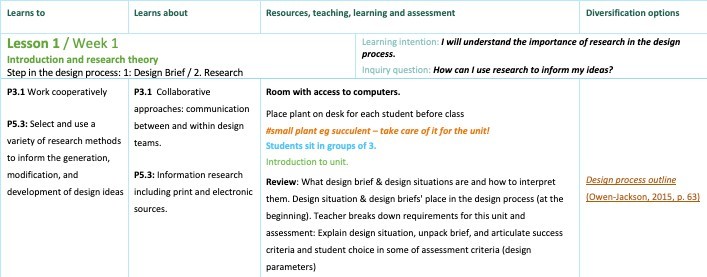 |
| – Outcomes are copied directly from syllabus
– The direct part of the outcome that is being taught is copied – Learning Intention included and relevant to outcome – Headings and hierarchy is clear and concise – Colour coding adds value for the reader Ideas for improvement – – Move Lesson number heading up – Resources are in the wrong column |
| EXAMPLE OF A BELOW STANDARD UNIT PLAN |
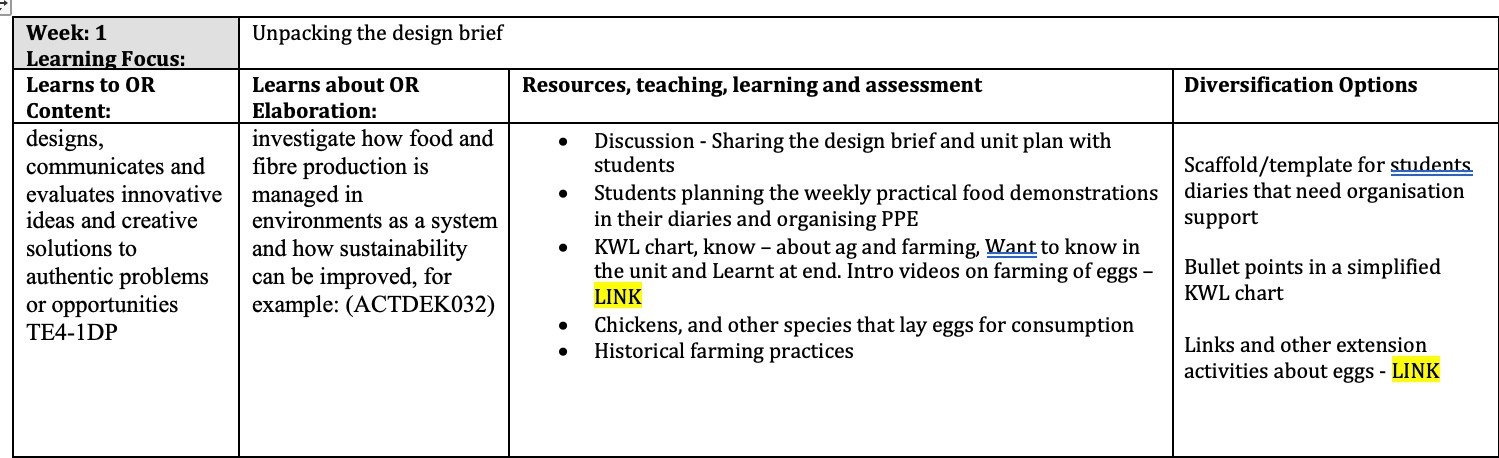 |
| – Outcomes link to learning focus
– Resources and teaching column doesn’t state teaching activities, bullet points of content not ways to teach – Resources not linked – Diversification options are good, they highlight what is being modified
Ideas for improvement – – Describe the resources, teaching , learning and assessment with greater detail and name the strategies/resources – Check the Learning Focus, outcomes, teaching activities, and resources ALL align – Ensure when you are moving cells and information you don’t mistakenly miss something like this |
| EXAMPLE OF GENERAL OVERVIEW (non specific) AND GREAT DIVERSITY ADJUSTMENTS |
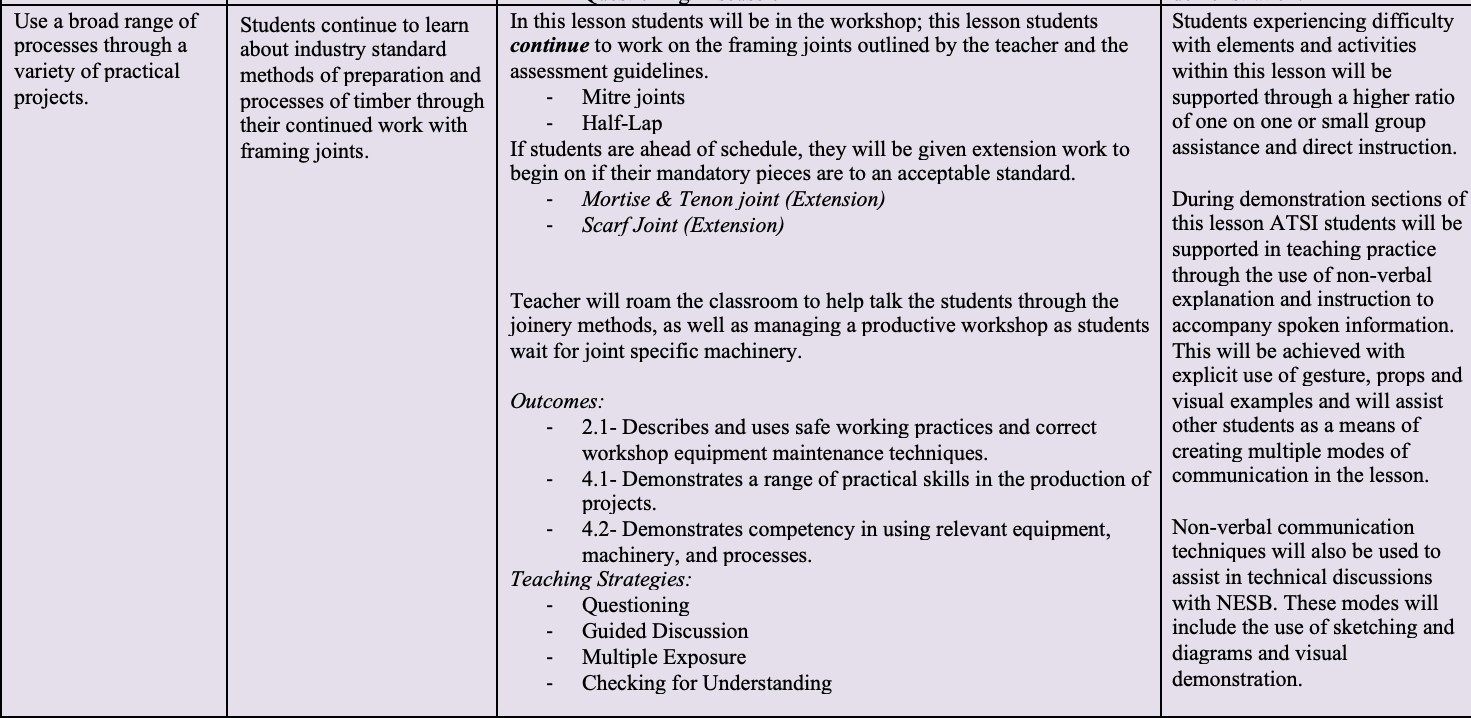 |
| · Outcomes should all be on the left
· “in the lesson statement” provides a good summary · Strategy list is disconnected and not linked to activities – this in an easy fix PRIOR to marking – eg: what task is questioning being used for? · Diversity column is excellent, would be AMAZING if linked with the middle column Ideas for improvement –
– IF time permitted, this student could have reduced the words in the diversity column. This number of words is not a requirement QUICK fixes – – Move the outcomes – Put a dash next to the teaching strategies and describe the activity – Add resources/links to the Mortise and Tenon |
| EXAMPLE OF TURN ITIN DETECTING GOOD COPY AND PASTING |
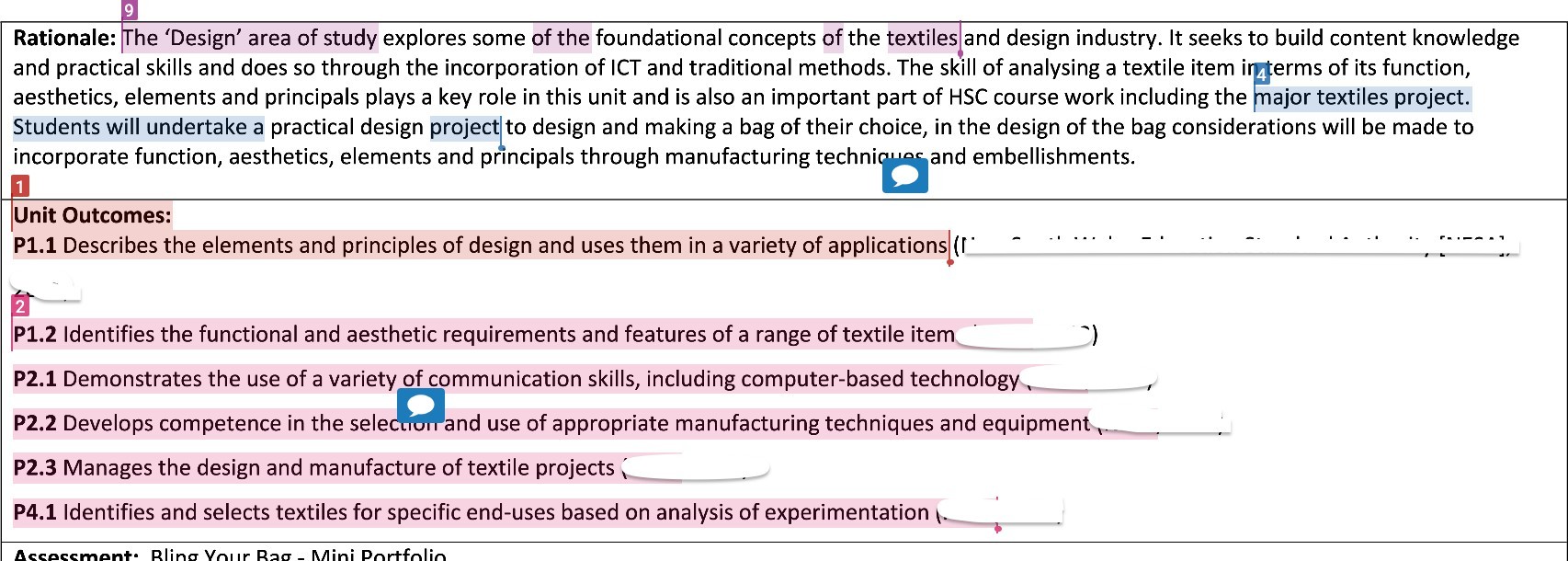 |
| This highlight from turnitin demonstrates to the marker you have copied outcomes correctly. |
EXAMPLE OF GREAT TIMELINE AND DESCRIPTIONS OF TEACHING AND LEARNING
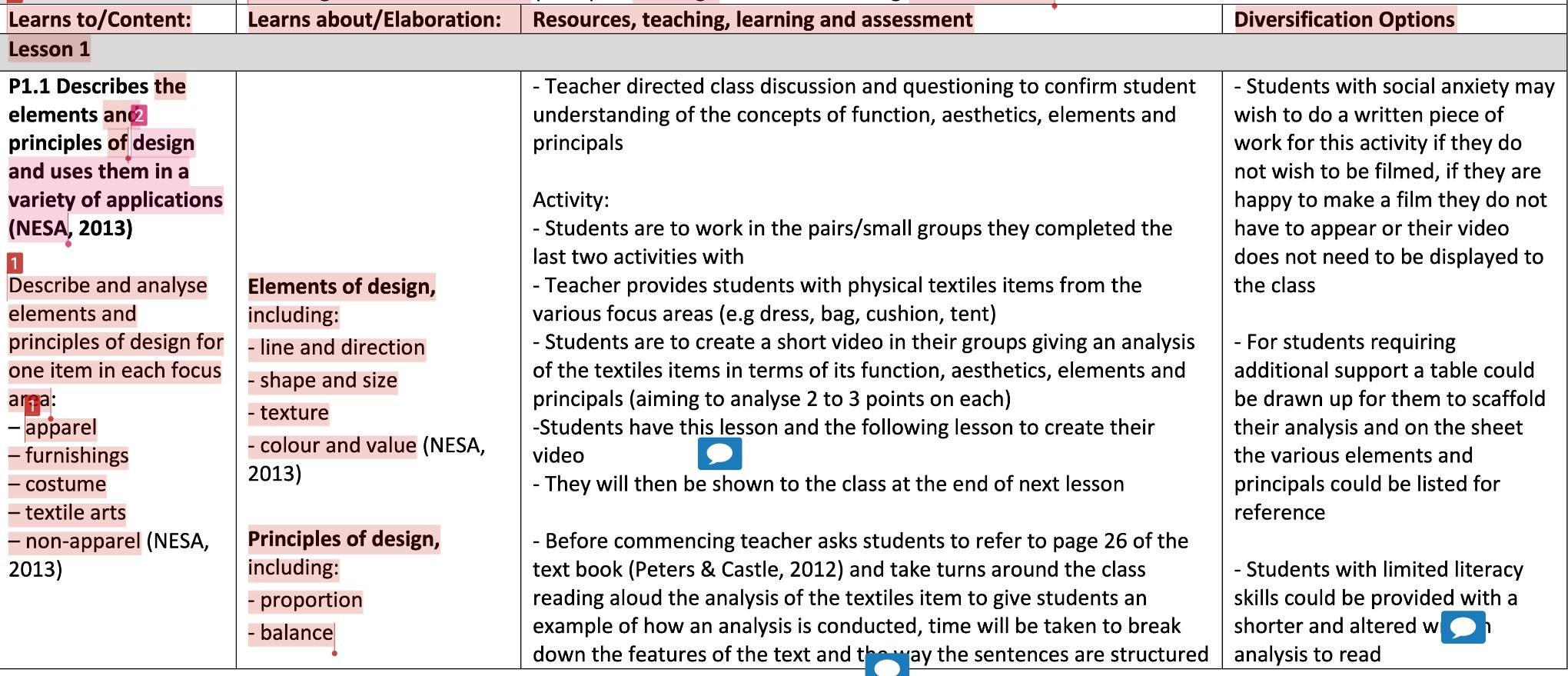 |
| – Example of clear descriptions of activities linked to outcomes
– Good diversification column
Ideas for improvement – – Referencing outcomes in this way is NOT required – To elevate this further, strategies could be named eg: modelling, worked example, ICT, literacy. . . |
2026 EDUC2006 UNIT PLAN TEMPLATE
| Year: | Course & Context: |
| Unit/Topic Name: | Indicative Time: |
| Rationale:
The unit overview should reflect the rationale, aims and key ideas of the learning area/s and/or subject/s. It may be progressively completed as the unit is developed. Describe the focus and context for learning in this unit. For example: Explain why this unit is important. Explain how this unit contributes to achieving school or sector priorities, e.g. literacy, numeracy, values education, equity. Identify the ‘big ideas’ of the unit, including the key content, concepts, conceptual links and context. Identify the inquiry questions that will shape inquiry in this unit. Identify students’ prior learning and areas to be consolidated through the unit.
|
||
| Unit Outcomes:
The outcomes from your curriculum should be copied/pasted in full into a bulleted list
|
||
| Assessment: propose this
|
||
| Mode:
o Folio o Oral o Practical |
o Research task
o Interim feedback/checkpoint o ICT skills o Quiz/test |
o Writing sample
o Questioning o Comprehension o Examination |
| Weighting:
Task/s: |
||
| General capabilities
|
|
| Identify the general capabilities that will be embedded in the unit.
· · |
Describe how the general capabilities will be embedded in teaching, learning and assessment for this unit.
· |
| Cross curriculum priorities
|
|
| Identify the cross-curriculum priorities that will be embedded in the unit.
· · |
Describe how the general capabilities will be embedded in teaching, learning and assessment for this unit.
· |
Strategy Mapping: highlight what you use
| Cognitive Organisers
o Brainstorming o Discussion o Mind map o Cause & effect o Fact/opinion chart o Venn diagram o SWOT analysis o Fishbone o KWL chart o Four step questions o Other: |
Diverse Needs
o Vocab work o Scaffolds o Additional time o Modified assessment o Digital assistance o Alternate assessment o Reduction o Other: |
Literacy and Reading Strategies:
o Structured overview o Dictagloss o Jigsaw o Cloze passages o Vocab banks o Three level guides o Sequencing o Matrix o Skimming & scanning o Joint construction o Gist o Other: |
Work, Employment & Enterprise
o Learning o Communication o Technology o Team work o Planning & organising o Problem solving o Allocation of roles o Self-management o Enterprise |
| Gifted & Talented
o Extension Activities o Adding difficulty degrees o Reciprocal teaching o Extension classes o Other : |
|||
| Critical and Creative Thinking:
o Interpreting o Analysing o Evaluating o Explaining o Sequencing o Reasoning o Comparing o Questioning o Inferring o Hypothesising o Appraising o Testing o Generalising o Reflecting o Generating ideas |
Text-Types
o Reports o Discussions o Expositions o Procedures o Recounts o Explanations o Narratives o Other:
|
ICT & Digital Skills
o Word Processing o PowerPoint/Keynote o Excel o Internet research o Spreadsheets o Databases o Graphics o Podcasting o Collaborative texts – wikis, blogs, Google Classroom etc o Formatting & Presenting o Other:
|
Activities included in this unit will address the following learning styles:
o Reading o Watching o Doing o Listening
|
| Numeracy Activities
o Estimating and calculating o Recording data o Spatial reasoning o Using measurement o Geometry, scale, proportion o Modelling and drawing o Computational thinking |
Copy this table for each week of the unit, each outcome should be a new row, the total list of activities should cover a week of classes.
| Week:
Learning Focus: |
|||
| Outcome: | Elaboration: | Activities, strategies and resources | Diversification options |
| Copy this from your curriculum/syllabus
Eg: FT4-7 identifies the factors that influence food habits and relates them to food choices |
Copy this from your curriculum/syllabus, make sure rows correspond
Students develop: knowledge and understanding of nutrition and food consumption, and the consequences of food choices on health |
Create a bulleted list of in-class activities and strategies that align to the outcome on the left with any resources referenced by title and URL (NOT APA7)
· Explicit instruction of the Australian Dietary guidelines · Students work in teams to create a meal plan that demonstrates understanding of food choices · Watch a video that is about how varying cultural and religious backgrounds impact food habits |
What relevant adjustments could be put in place for these activities?
|
2026 EDUC2006 LESSON PLAN TEMPLATE
Lesson Plan Template
Timing: |
Year Group: |
Date: |
Learning Focus:
Copy from the unit plan weekly heading |
Learning Intention:
Success criteria: |
Outcomes:
Copy this from your curriculum/syllabus
|
| Time | Activities and strategies | Resources required | Teacher actions | Expected student actions | Diversity and Assessment |
| 3mins | Copy from the unit plan | Copy from the unit plan: eg: stationery,, websites, handouts etc | What do you need to do for this to be successful? | What will students be doing? | Copy from the unit plan
|
|
|
|||||
|
|
|||||
|
|
|||||
|
|